
Currently Empty: $0
More CoursesWhy Don’t I Feel Like Myself After Childbirth?
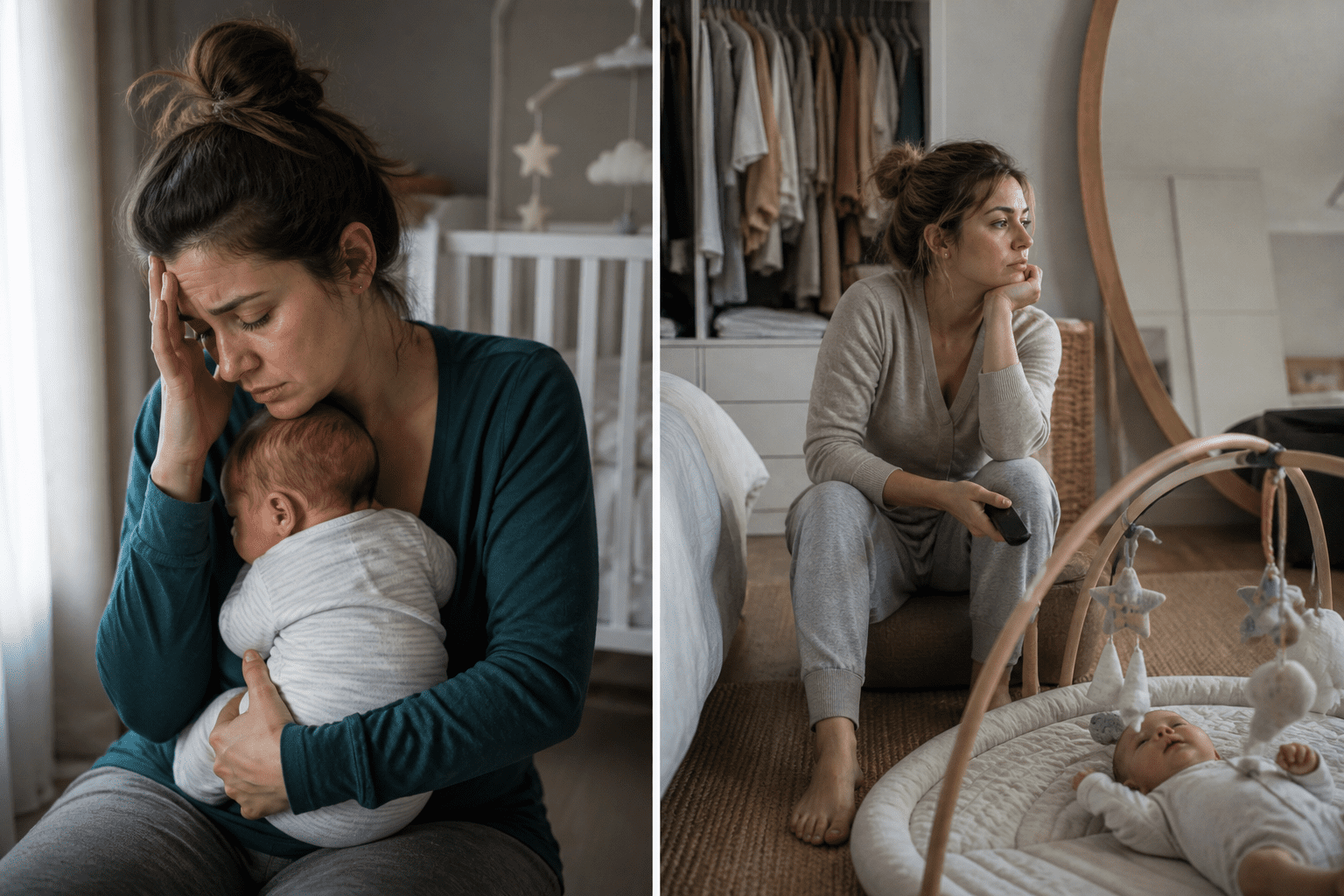
If you feel like you’re losing yourself after having a baby, you’re not broken. A supportive, real-talk guide to matrescence, postpartum recovery, and feeling like you again.
It is midnight, the whole house is finally quiet… except your baby. That tiny snuffle-breath, the little squeaks, the restless kicks in the bassinet next to you.
You have just finished a feed. Your back is screaming. Your hair is in a bun that has officially stopped being a “messy bun” and it has become a “please don’t look at me” bun.
And then it happens.
You look at your baby, and your heart feels a lot of emotions altogether: love, protectiveness, worry.
However, when you catch your reflection in the mirror, there is this other thought. The one which you don’t say out loud because it sounds ungrateful.
“I love my baby… so why don’t I feel like myself after childbirth?”
Have you asked yourself that? Even once?
If yes. You are not alone. Not even a little
In a lot of homes, the spotlight is only on the baby (as it should be), and on “taking care of the mother” in practical ways, food, massages, visitors, rituals, and advice. But nobody really sits you down and says:
“What happens when you miss you?”
This is the part that can feel quietly shocking. One day, you were you, your routines, your work, your friendships, your music, your preferences, your body being yours, and suddenly, you are introduced as “the baby’s mom,” and it is like your name becomes optional.
That feeling, losing identity after having a baby, is a real, normal emotional transition. You are not disappearing. You’re transitioning.
Your Body and Brain Are Undergoing a Massive Reset (And Nobody Warns You Properly)
We talk about childbirth like it is a finish line. Delivery is done, baby is here, “congratulations,” and the end of the story.
But that is just the beginning.
Postpartum recovery is more like… moving houses while you are still living inside the house.
Sleep, hormones, identity, relationships, your body, your brain…everything is shifting at once.
During pregnancy, the estrogen and progesterone run sky-high, and then after birth, those levels drop fast like your internal volume knob gets turned down overnight. No wonder you feel teary, flat, irritated, anxious, or weirdly “not in your body.”
With all of this, your brain changes too.
A study in Nature Neuroscience found that parts of a mother’s brain remodel during pregnancy and postpartum changes linked to bonding and responding to your baby (Barba-Müller et al., 2019). Which sounds beautiful… until you are standing in the kitchen staring at the fridge thinking, Why can’t I remember what I came here for?
If you used to be the one who handled deadlines, plans, mental lists…almost everything and now you feel foggy or slow, it means your brain is doing high-level renovation work while you are also running on broken sleep.
So if you are thinking, “I don’t recognise myself after having a baby,” That is your nervous system telling the truth.
The Identity Shift:
Now let me introduce you to matrescence.
Matrescence is the emotional and psychological transition into motherhood. It was coined by anthropologist Dana Raphael and later spoken about more widely in maternal mental health spaces. Well….if you’re sitting there thinking, “Okay, but why does it feel so intense?” that is exactly the point. It is intense.
A lot of people draw parallels with matrescence and growing up as a teenager. It’s just such a great comparison. Do you remember growing up as a teenager? Your body’s changing, your moods are all over the place, your relationships are changing, and this is all accompanied by this question of: Who am I now?
Motherhood can bring that same identity-questioning energy, just with a baby in your arms and no sleep.
One day, you were a person with a whole life. Preferences. Private thoughts. Confidence in certain rooms. A way of dressing, talking, working, and dreaming.
One day, you were a person with a whole life. Preferences. Private thoughts. Confidence in certain rooms. A way of dressing, talking, working, and dreaming.
And then suddenly, your days can shrink into:
- feed
- burp
- nap (baby)
- cry (you? baby? both?)
- repeat
If your thoughts have been something like, ‘My old life feels so far away,’ or ‘I miss the version of me that didn’t feel on duty all the time’… that’s a very real shift that happens after having a baby.
I want to remind you that your old self did not vanish. She’s not gone.
She’s just being rearranged. Expanded. Made room for.
I will not deny the fact that it feels like grief sometimes, even when you love your baby more than you thought was humanly possible.
When the “Baby Blues” Make You Feel Even More Like a Stranger to Yourself
It is difficult to feel like yourself when you’re crying because:
- The toast fell,
- Your top has milk stains again.
- Your baby made a new sound, and your brain decided it meant “danger.”
- Your partner is breathing too loudly (why is it so loud though?).
That early postpartum stage can feel like your emotions have no skin. Like everything touches you too deeply.
Around 60–80% of new mothers experience the baby blues in the first two weeks after childbirth. It can look like:
- Unexplained crying (even on “good” days)
- Feeling overwhelmed by small tasks
- Irritability, mood swings, feeling extra sensitive
- Anxiety about the baby’s well-being (checking, Googling, re-checking)
When you are in that emotional turmoil, if you already feel like you are losing yourself after having a baby, the blues can make it feel like you will never come back.
Usually, baby blues ease as hormones stabilize and sleep improves. However, if your baby blues persist for more than two weeks or feel severe, frightening, and/or uncontrollable, then it could be more than baby blues.
If you want a clear, gentle breakdown, our blog on Postpartum Anxiety vs. Baby Blues, is especially helpful if you feel stuck in that constant “high-alert” mode.
Why It Can Feel Like You’ve “Lost Yourself” After Having a Baby
Postpartum is your entire life being re-centred around a tiny person who can not tell you what they need… but needs you anyway.
So why does losing identity after having a baby hit so hard?
1) You don’t get to be alone anymore (even when you desperately need it)
Before, even if life was busy, you had pockets of privacy. A quiet drive. A scroll session. A cup of tea that stayed hot.
Now? Even “rest” can feel like you are on standby. When you lose those small moments, you also lose the moments where you used to hear yourself think.
In many South Asian households, “me time” can come with guilt attached to it, as if selfhood is a luxury item, but you are not asking for luxury. You are asking for oxygen.
2) The mental load is nonstop
It is not just diapers and feeds. It is thousands of tabs open in your mind all day:
Is my baby eating enough? Is that rash normal? When is the next vaccination? Did I sterilise the bottle? She’s sleeping too much, should I wake her up? Why is my baby not sleeping? Is she too hot? Too cold?
This invisible checklist is exhausting and tiring. When your brain is full of baby logistics, it can feel like your old interests, maybe it is listening to music, reading books, your office work, your daily skincare, fitness, and friends, have been pushed into some back cupboard.
3) The “perfect mother” pressure is loud (even if nobody says it directly)
There’s Instagram perfection. Some relatives mean well, but still say things that sting. There’s that unspoken expectation that you should be endlessly grateful, glowing, and motherly 24/7.
So when you’re not feeling blissful and you’re also thinking, “I miss my old life”—the guilt kicks in. And guilt is isolating. It makes you hide your real feelings, which makes you feel even more alone in them.
And just to ask you gently: when was the last time someone asked how you are—without immediately adding “and the baby?”

How to Start Feeling Like “You” Again (Without Pressure to “Bounce Back”)
First, a reminder you might need to borrow until you believe it: you’re not trying to go “back” to who you were. You’re trying to feel at home in yourself again.
This is the matrescence part, your identity is shifting. So instead of forcing a “return,” think reconnection. Small. Kind. Realistic.
1) Find your people (because isolation messes with your head)
When you’re alone with these thoughts, they can sound like proof that something is wrong with you.
When you say them out loud to another mother and she goes, “Same,” something softens.
Ask yourself: Who sees me as a full person right now, not just as someone’s mother?
2) Bring back tiny rituals (the ones that whisper “I’m still here”)
You don’t need a huge makeover or a perfect routine. You need small anchors.
Maybe it’s:
- putting on your favourite earrings even if you’re in a feeding kurta,
- one song a day that has nothing to do with babies,
- a five-minute skincare routine,
- journaling one line: “Today I feel ___ and I need ___.”
These aren’t “extras.” They’re reminders. Your brain needs proof that you still exist beyond caregiving.
3) Give it time, actual time
This is the part people hate hearing, but it’s also the part that can set you free: postpartum recovery takes time.
Not just your body. Your mind. Your confidence. Your identity.
Some women start feeling more like themselves at 3 months. Some at 9. Some at 18. Many feel it in waves better for a while, then wobbly again after a sleep regression or return-to-work stress.
So if you’re thinking, “Why don’t I feel normal yet?”, you’re not behind. You’re in process.
You Haven’t Lost Yourself. You’re In the Middle of Becoming.
If you’ve been feeling like you’re kind of fading into the background… like you’re not really the main character in your own life right now… just pause for a second.
It’s a weird feeling, right? It can start to feel like you’re disappearing a little. Like you’re still there, doing everything, showing up… but not quite as yourself.
Your humour, your opinions, your intelligence, your preferences, your ambition, none of that has actually gone anywhere.
It just gets harder to access when you’re running on
- broken sleep,
- hormones,
- constant responsibility,
- and the emotional weight of loving someone this much.
That is matrescence, and it’s real.
If your concern is that your worry is becoming loud, if you are feeling stuck in panic, dread, racing thoughts, or constant “what if” scenarios, then please know that you shouldn’t try to power through this on your own. Support isn’t a luxury in postpartum care; it’s care.
Our Postpartum Anxiety Course is designed specifically with women who feel overwhelmed, “lost,” or stuck in that never-ending mental cycle. It’s practical and simple (because you don’t need more homework). It’s meant to help you feel steadier in your body and clearer in your mind so that you can find your footing again.
You are a whole person.
A woman, and a mother, at the same time.
And you deserve to feel like yourself again.
References
- Barba-Müller, E., et al. (2019). The plasticity of the social brain: Maternal and paternal changes. Nature Neuroscience.
- Saks, A. (2017). The Birth of a Mother. Scientific American.
Stein, A., et al. (2014). Effects of perinatal mental disorders on the fetus and child. The Lancet.
Other Blogs
 May 7, 2026
Postpartum Anxiety vs. Baby Blues: Understanding Your Emotions After Birth
Feeling more anxious than happy after birth? Learn the difference between baby blues and postpartum anxiety, why slee...
Read More May 7, 2026
Is Productivity Culture Increasing My Stress as a Mom?
Feeling overwhelmed by the pressure to do it all? Learn how hustle culture affects working mothers and discover pract...
Read More May 6, 2026
Why Can’t I Switch Off My Mind After a Workday?
Learn why your brain stays active after work and how to stop overthinking to recover from burnout. Start your Working...
Read More May 6, 2026
Why Does My Mind Never Stop Thinking?
Struggle with mental exhaustion and overthinking? Learn how to stop racing thoughts and manage work stress with these...
Read More