
Currently Empty: $0
More CoursesWhy Do I Panic Even When I’ve Studied Everything?

tudying hard but still panicking? Learn why the fear of academic failure triggers exam stress and how to stop the spiral before your next test.
You have studied everything possible. The flashcards are worn out, your notes are highlighted, and you could probably run through the textbook in your sleep. Logically, you know the material. Then you get closer to the exam. Or you sit down in that quiet hall, and something feels off. Your heart starts racing. Your palms feel sweaty. Your breathing changes. That “ready” feeling slips away and gets replaced by pure panic.
If this sounds familiar, you are not the only one. This panic does not mean that you are “bad at tests,” and that you have forgotten what you learned. In this moment, you are experiencing a specific kind of anticipatory anxiety where your brain stops seeing a test and starts seeing a threat.
The Hidden Driver: It’s Not About the Books
The largest misconception about stress relief for exams is that we just need more studying. However, the problem is that when we have studied it all, the stress is not merely about the books or the portion that you have to complete, it’s about the result.
For many of us, a test is a performance review of our entire worth. We start carrying the heavy weight of:
- Fear of academic failure: "If I do not get an A, then I am a failure as a person."
- Disappointing our parents: The invisible pressure of having to live up to the sacrifices or expectations of our parents.
- The "Not Good Enough" trap: The belief that our grades and self-worth are the same thing.
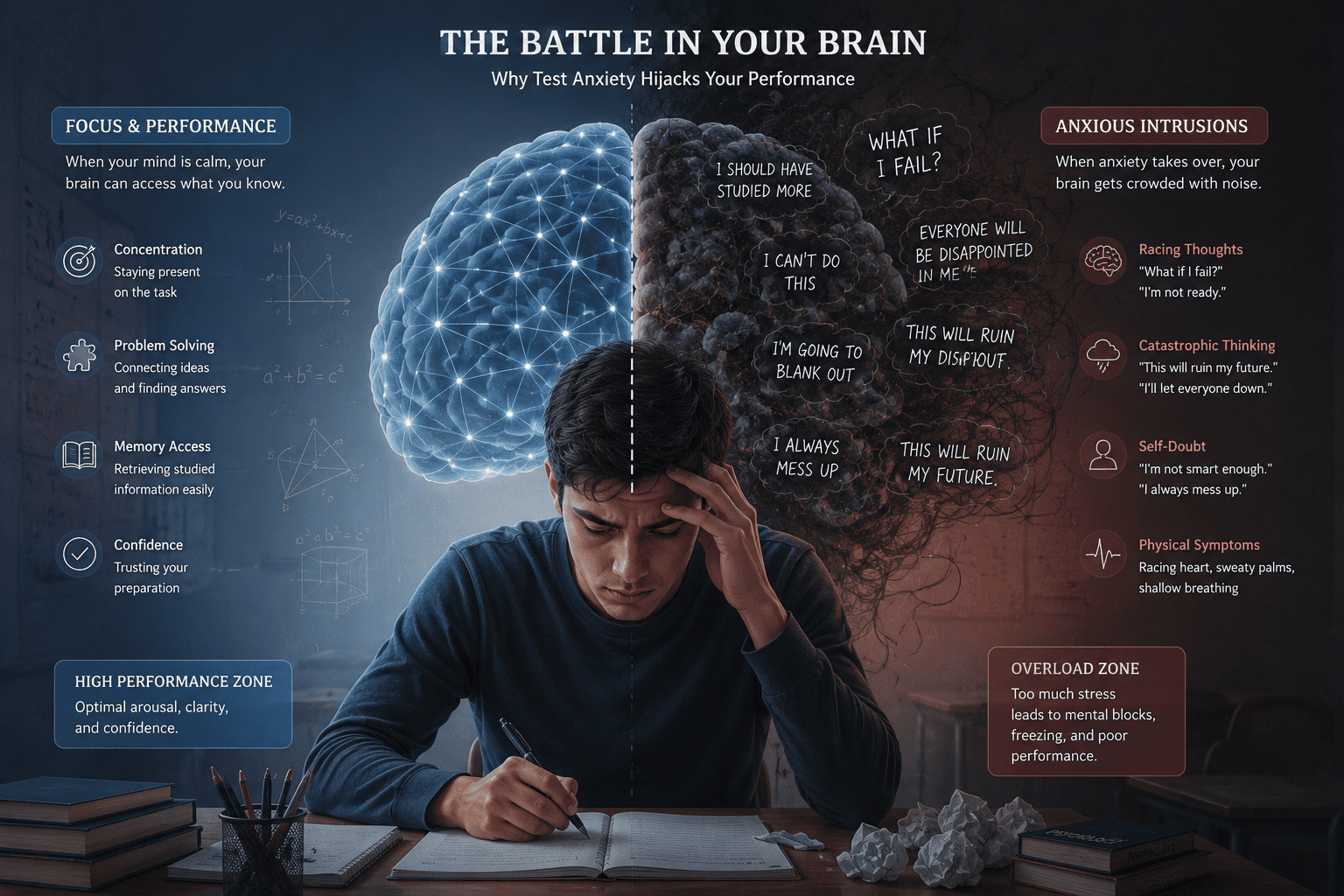
Here is what happens inside our body: When the pressure is this high, your brain’s survival center (the amygdala) takes over. It doesn’t care about the Pythagorean theorem; it cares about protecting us from the “dangers” of not passing the test.
Sometimes this pressure makes our mind go blank during tests. If you have felt that familiar blankness during a test check out our blog on Why Does My Mind Go Blank During Important Tests?
Why Logic Doesn’t Work (The Science Bit)
You might try to talk yourself down. “I know this! I got 90% on the practice test!” But the panic stays. Why?
Psychologist Irwin Sarason developed a concept called Cognitive Interference Theory. He suggested that for people with high test anxiety, their “internal noise”: those intrusive, self-deprecating thoughts: actually competes with the task at hand. Instead of your brain using 100% of its power to solve a math problem, 50% of it is occupied by thoughts like, “What if I fail? My mom is going to be so disappointed. I’m so stupid for panicking.”
Basically, your “thinking brain” is being jammed by an emotional signal. This is why overcoming test anxiety is about more than just better revision; it’s about managing the “noise.”
The Thought Spiral: From 0 to 100
Panic usually follows a very predictable, very exhausting loop:
- The Trigger: You see a question you don’t immediately recognize.
- The “What If”: “What if I forget everything else?”
- The Catastrophe: “If I fail this, I won’t get into a good college, and I’ll never get a job.”
- The Body Response: Your heart races, which makes you panic more because you feel like you’re losing control.
Tool: How to "Contain the Spiral"
When the “what ifs” start, here’s what to do instead: This 2-minute reality check:
- Write the Worst-Case Scenario: Actually put it on paper. “I fail the test, my GPA drops, and I have to retake the class.”
- The Reality Check: Ask yourself, “Is this a life-threatening disaster, or a really uncomfortable setback?” (Hint: It’s always the second one).
- The “Next Step” Plan: If the worst happened, what would you do? You’d talk to the teacher, find a tutor, or try again. Knowing you have a plan for the “disaster” takes the power away from the fear.
You’re Not Alone
It’s okay to care. In fact, you’re likely panicking because you care so much. But your brain needs to know that you are safe, even if you don’t get a perfect score.
If you are tired of your hard work being ruined by a racing heart, our Overcome Test Anxiety Course is designed to help you train your nervous system to stay calm when it matters most. The course will teach you the exact tools that will help you separate your worth from your grades so that you walk into your next exam feeling in control.
References
- Sarason, I. G. (1984). Stress, anxiety, and cognitive interference: Reactions to tests. Journal of Personality and Social Psychology.
- Zeidner, M. (1998). Test Anxiety: The State of the Art. Plenum Series on Stress and Coping.
Other Blogs
 May 7, 2026
Why Don’t I Feel Like Myself After Childbirth?
If you feel like you’re losing yourself after having a baby, you’re not broken. A supportive, real-talk guide to matr...
Read More May 7, 2026
Postpartum Anxiety vs. Baby Blues: Understanding Your Emotions After Birth
Feeling more anxious than happy after birth? Learn the difference between baby blues and postpartum anxiety, why slee...
Read More May 7, 2026
Is Productivity Culture Increasing My Stress as a Mom?
Feeling overwhelmed by the pressure to do it all? Learn how hustle culture affects working mothers and discover pract...
Read More May 6, 2026
Why Can’t I Switch Off My Mind After a Workday?
Learn why your brain stays active after work and how to stop overthinking to recover from burnout. Start your Working...
Read More