
Currently Empty: $0
More CoursesWhy Does My Mind Go Blank During Important Tests?

Ever sat down for an exam and suddenly forgotten everything? It’s not your memory; it’s a nervous system freeze. Learn how to stop study anxiety and unfreeze your brain in 60 seconds.
You have done the work. Weeks of highlighting everything in neon yellow, drinking a little too much coffee, and yes… explaining theories out loud like your cat is actually listening. You know this stuff. You have done the practice tests, you have revised, and you were literally fine just a couple of hours ago, and then you sit down for the exam.
The room goes quiet in that uncomfortable way. The clock suddenly feels louder than it should. You look at the first question, something you explained perfectly before, and your brain just goes blank. Not just “fuzzy” or “hard to remember,” but totally, completely blank. Your mind is a white screen. A void.
If you have experienced this, I want you to take a deep breath right now. What you are experiencing is a nervous system shutdown, commonly known as a freeze response, which is one of the most frustrating parts of test anxiety.
It’s Not a Memory Problem: It is a Security Problem
When we talk about overcoming test anxiety, we usually focus on “studying harder.” But the truth is, you can’t study your way out of a physiological survival mechanism.
Think of your brain like a high-end computer. Your “thinking” part: the Prefrontal Cortex: is where you store your exam prep, your logic, and your ability to write essays. But there’s a smaller, much faster part of your brain called the amygdala. Its only job is to look for danger.
When you feel the weight of an important exam, your brain doesn’t distinguish between a “Final Grade” and a “Saber-Toothed Tiger.” It simply sees a threat. When the pressure hits a certain level, the amygdala hits the panic button. It floods your system with cortisol and adrenaline, effectively pulling the plug on your Prefrontal Cortex to save energy for “survival.”
Basically, your brain has gone offline to protect you. It’s hard to solve for ‘x’ when your body thinks it’s fighting for its life.
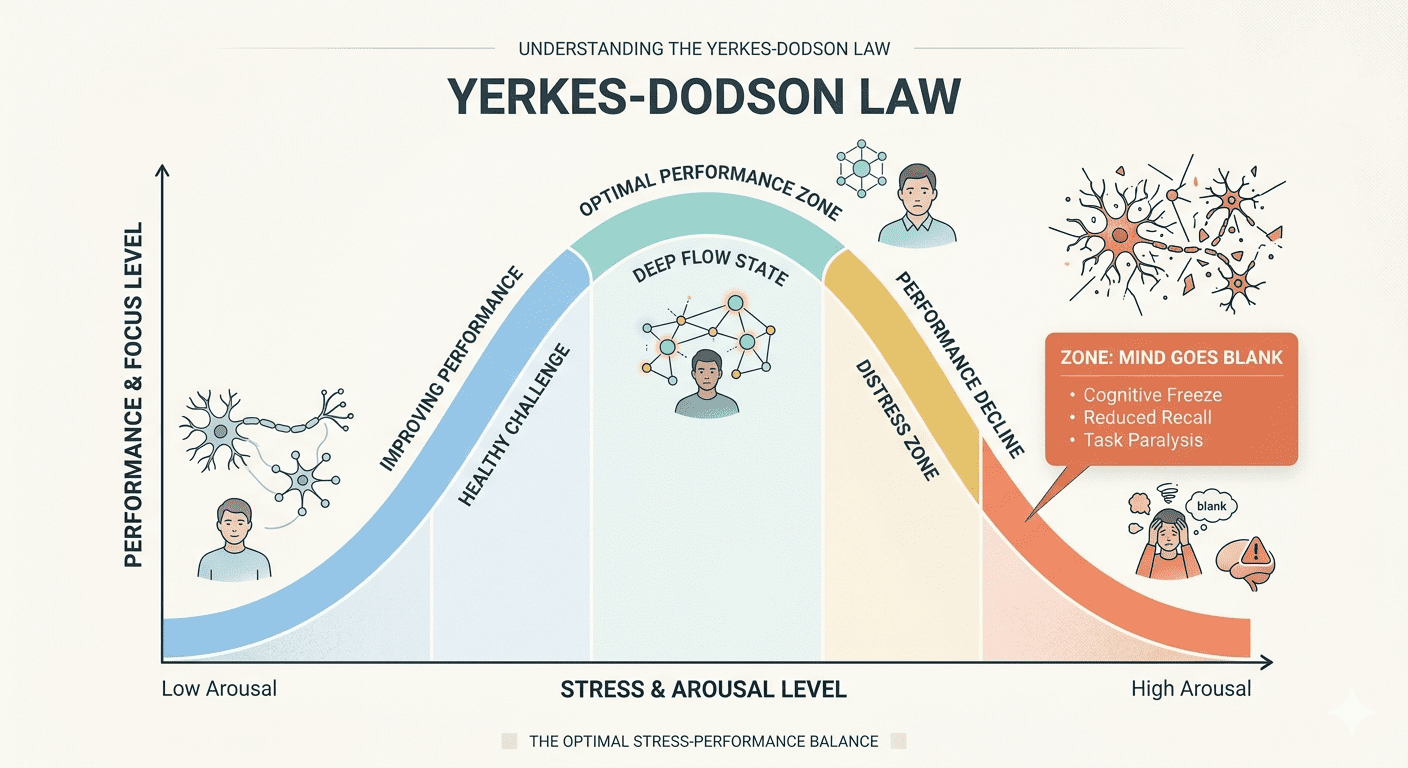
The Science: Why the "Blank" Happens
This isn’t just a feeling; it’s rooted in what psychologists call the Yerkes-Dodson Law. This principle suggests that we actually need a little bit of stress to perform well (arousal). A small amount of stress keeps us at our best. But when that stress increases even slightly past that point, our performance plummets.
When you reach that “cliff,” your nervous system goes into “Freeze” mode, as suggested by the Polyvagal Theory. This theory, as developed by Dr. Stephen Porges, refers to the way in which your heart rate, breathing, and brain respond to your perception of safety. In the “Freeze” state, your heart rate might actually slow down, your muscles might feel heavy, and your brain enters a state of dissociation.
The fear of academic failure becomes so intense that your system decides the safest thing to do is to “shut down” or freeze. This explains why you feel numb, stuck, and: you guessed it… blank.
When this happens, most of us usually start panicking and if you want to know why we panic don’t forget to check out our blog on Why Do I Panic Even After Studying Everything?
Why Exams Trigger This Specifically
Most of the time, it is not usually the content of the exam that is causing the issue. It is the “What-If’s?”
- "What if I fail and disappoint my parents?"
- "What if I do not get into the program that I want?"
- "What if everyone thinks that I am stupid?"
This is the point at which grades and self-worth become perilously intertwined. When we perceive that a single piece of paper determines our worth as a human being, the “threat” becomes too great to overcome and our nervous system starts screaming for help.
Now let us explore the signs that suggest that you are Going Into a Freeze State
Other than the obvious “mind blank,” you should look out for these signs too during an exam:
- Slowed thinking: Even after reading the same sentence 10 times, it still doesn’t make sense to you.
- Disconnected: You feel spaced out, like you are watching yourself from far away.
- Physical numbness: Your hands may feel cold or tingly.
- Tunnel vision: You can only focus on the paper in front of you, and the rest of the room feels distant.
The "Unfreeze in 60 Seconds" Micro Tool
If you feel the blankness coming on, you have to talk to your body before you can talk to your brain. You cannot “logic” yourself out of a freeze. You have to regulate your nervous system first.
Try this 60-second reset the next time you are feeling a void in your life:
- Drop Your Anchor: Push your feet as hard as you can into the floor. Feel the weight of your body in the chair. This tells your brain, “I am physically here and I am safe.”
- The Long Exhale: Inhale for 4 seconds, but exhale for 8 seconds. Long exhales stimulate the vagus nerve, which acts as a “brake” for your stress response, signaling to your brain that the “tiger” has left the room
Reframing the Blank
The next time your mind goes blank, I want you to say this to yourself: “My mind is blank because it is trying to protect me. I am safe. I am just overwhelmed.”
A blank mind is not a sign of incapacity, it is a sign of an overtaxed system. By changing your focus from “I need to remember the answer” to “I need to help my body feel safe,” the memories will actually begin to return to you naturally. Once the “security alarm” (the amygdala) is turned off, the “computer” (the Prefrontal Cortex) can reboot.
Looking for exam stress relief isn’t about being “tougher.” It’s about being smarter about how your biology works
If your blankness frequently leads to actual physical distress, then you might want to read: Why Do I Panic Even When I’ve Studied Everything?
Validation Seeking
You don’t have to be a victim of your own nervous system. You can train your brain to stay “online” even when the pressure is high.
If you’re tired of all your hard work vanishing the moment you step into the exam hall, we’ve got something for you. Our Overcome Test Anxiety Course has been built to provide you with the very tools you need to succeed in these situations.
References
- Porges, S. W. (2011). The Polyvagal Theory: Neurophysiological Foundations of Emotions, Attachment, Communication, and Self-regulation.
- Yerkes, R. M., & Dodson, J. D. (1908). The relation of strength of stimulus to rapidity of habit-formation. Journal of Comparative Neurology and Psychology.
Other Blogs
 May 7, 2026
Why Don’t I Feel Like Myself After Childbirth?
If you feel like you’re losing yourself after having a baby, you’re not broken. A supportive, real-talk guide to matr...
Read More May 7, 2026
Postpartum Anxiety vs. Baby Blues: Understanding Your Emotions After Birth
Feeling more anxious than happy after birth? Learn the difference between baby blues and postpartum anxiety, why slee...
Read More May 7, 2026
Is Productivity Culture Increasing My Stress as a Mom?
Feeling overwhelmed by the pressure to do it all? Learn how hustle culture affects working mothers and discover pract...
Read More May 6, 2026
Why Can’t I Switch Off My Mind After a Workday?
Learn why your brain stays active after work and how to stop overthinking to recover from burnout. Start your Working...
Read More